

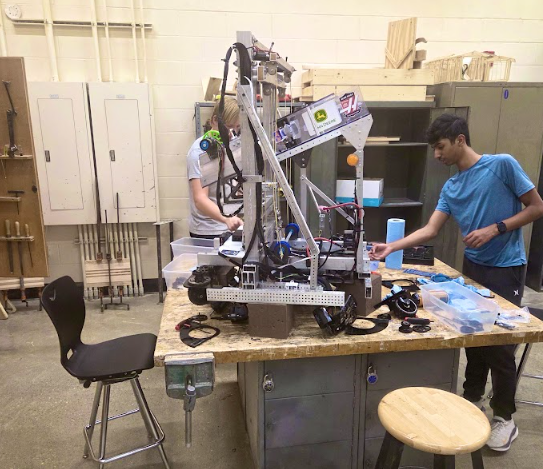
Long after school ends, the robotics lab is still full of students, laptops open and hands busy with tools. For many, the pressure of perfecting a robot is only matched by the excitement of seeing their work compete on a national stage.
Each January, teams in programs organized by FIRST (For Inspiration and Recognition of Science and Technology) are given a new game challenge. In the FIRST Robotics Competition (FRC), often considered the organization’s most advanced high school program, students have six weeks to design, build and program an industrial-sized robot capable of competing at regional or district events.
The timeline creates a fast-paced environment where innovation and urgency coexist. After the annual game reveal, teams meet to analyze rules, develop strategy and brainstorm designs. Within days, students divide into business, mechanical, electrical and programming subteams. The robot’s systems are interdependent so delays in one area can affect the entire project.
“It’s controlled chaos,” robotics coach Jason Franzenburg said. “During build season we meet between 16 and 24 hours a week, and that kind of commitment teaches students what real deadlines feel like. They learn quickly that engineering isn’t just about building something that works, it’s about collaborating, adapting and staying focused under pressure.”
That controlled chaos mirrors the real-world engineering environment that FIRST aims to replicate. Unlike a traditional classroom assignment, success in robotics depends entirely on collaboration. Students have to navigate tight deadlines, troubleshoot mechanical problems, rewrite malfunctioning code and adjust designs while balancing academic responsibilities.
Senior team project manager Elizabeth Otts described the process as demanding but formative. “There are nights we stay until 9 p.m. or later, especially close to competition,” Otts said. “It’s stressful but it pushes us to communicate clearly and stay focused under pressure.”
While FRC receives much attention for its scale, students in FIRST Tech Challenge (FTC) face similar pressure. FTC teams build smaller robots and often operate with fewer members, but the expectations remain high. Matches are fast-paced, and consistent performance is critical to ranking. Like FRC participants, FTC students must design, code, test and iterate their robots while balancing academic responsibilities and other extracurriculars.
Competition environments resemble sporting events more than science fairs. Teams wear matching shirts, wave banners and cheer loudly from the stands. Matches last only a few minutes, but weeks of preparation can hinge on a single mechanical failure.
Participants say the intensity prepares them for future careers. Robotics requires collaboration across specialties and the ability to solve problems under strict time constraints; skills applicable to engineering and beyond. Otts emphasized that the personal growth she gains outweighs the stress. “Even outside of robotics, I feel more prepared,” she said. “When something goes wrong, I don’t immediately panic. I break the problem down and look for a solution.”
Even when competitions end without a trophy, students often emphasize the growth they experienced. The pressure of the robotics season builds more than functional machines. It builds resilience, teamwork and the ability to perform under stress, qualities that extend beyond the arena floor.


