




PV’s FIRST Tech Challenge team, Deviation From the Norm, competed at Iowa’s state robotics competition alongside 72 teams on March 1. By the end of the night, they emerged as one of five Iowa teams advancing to the World Championship.
FIRST Tech Challenge (FTC) is a robotics competition under the FIRST umbrella organization. The FTC competition consists of three components: robot game, documentation and outreach.
Deviation From the Norm excelled in each of these categories throughout the season. At the state competition, they were a Finalist Alliance Captain, finishing as runner-up in the overall robot competition. They also earned the Think Award, a prestigious honor recognizing their portfolio, which documented their outreach, design process and team structure.
The team’s history spans 14 years, with a two-year pause during the COVID-19 pandemic. Their advancement to Worlds marked the first time a Pleasant Valley robotics team qualified for the competition.
To reach this milestone, Deviation From the Norm had to hit the ground running.
Pre-season:
Deviation’s season started in the summer, months before the annual FTC kickoff. The team’s preparation included participating in outreach events and developing team members’ design and programming skills.
“Pre-season involves planning and workshops. We start thinking about outreach goals around July, and project managers plan what we want our season to look like. Alongside this, we were all building our skills in workshops hosted by our professional mentors,” shared senior and co-team business manager Elizabeth Otts.
Their early start laid the foundation for success in both the robot game and documentation. By involving professional mentors, the team gained professional feedback and guidance as they entered the season.
The pre-season was also when the team established its outreach focus, which aims to increase access to and awareness of FIRST.
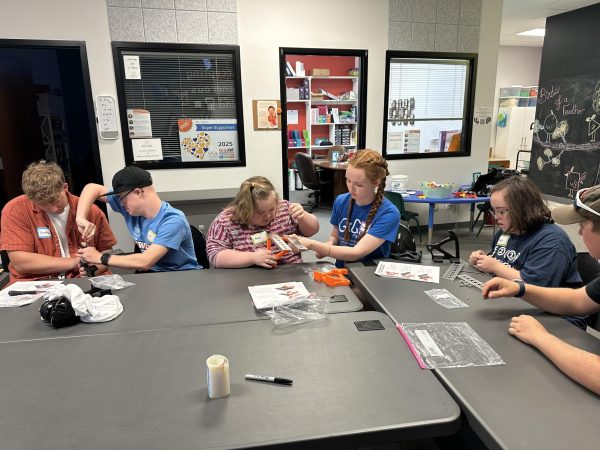
“Most of our outreach is determined by the community members who reach out to us for projects. This year, our theme of accessibility was decided by a project with GiGi’s Playhouse in Davenport,” said Otts. “We started planning this in early June, and it resulted in a six-week workshop where participants learned to build, drive, present and program. The initiative evolved into other custom design projects and events throughout the community.”
The combination of planning and outreach set the stage for the official start of the season on Sept. 6, 2025.
The season:
Technical mastery plays a fundamental role in ensuring teams’ success in the robot game. Building a competitive robot takes time and countless iterations to be successful in the competition.
Jonathon Hawkes, Deviation’s technical project manager and robot driver, prepared the technical team leaders through practice and guidance.
“I developed the technical skills for my team by teaching new team members the basics of CAD and building. The team bought a pre-existing kit of parts to build a robot at the beginning of the season to give the newer members the opportunity to test their skills that they had been taught,” said Hawkes. “Over time, this allowed the newer members to grow their technical skills and get the opportunity to design components on the feature robot for this season.”

Despite careful preparation, challenges can always emerge when building a robot. To overcome this, Deviation spent countless hours troubleshooting subassembly designs, developing prototypes and refining their design into a cohesive robot.
Hawkes and the design team broke the robot down into three subcategories: intake, indexer and launcher. Using the engineering design process, the members found efficient ways to develop each subassembly to overcome design constraints.
Once the robot was built, each system was tested repeatedly to identify areas for improvement, followed by further refinements.
“Designing this robot was a big challenge, but it was a great learning experience overall,” expressed Hawkes.
The competition:
Deviation’s competition season involved reflection and organization. They approached each aspect of the game with confidence by thoroughly preparing each team member.
For team co-business manager Malea Johnson, the preparation included consistency in all facets of the judging process. “To prepare for the competition season, we really focused on making the robot and portfolio solid without making drastic changes right before our competitions, so that we felt confident in how we were going to perform,” she said.
FTC judging includes an in-person interview where teams present their outreach efforts and robot design. These evaluations factor into which awards teams will receive.

The team was aware of their potential for the season and worked hard to convey that to judges. “I knew that my team and I gave 100% of our effort into every aspect of the game, so I was going to be happy with our performance no matter what,” shared Johnson. “I was a little nervous going into the presentation and for judge interviews; however, I assured myself that I knew all of the information about our team and that we were making a real impact with all of the events we’ve done, we just had to convey that to the judges properly.”
As they prepare for Worlds, the team intends to refine their current documentation and presentation rather than making major changes, allowing them to enter the competition with consistency and confidence.
The future:
To continue their momentum, Deviation keeps an organized summer structure to retain knowledge and develop team members’ skills. “We provide off-season training in regards to design process, manufacturing, programming and project management,” said Deviation’s coach and engineering teacher Jason Franzenburg. “We will select our project managers for next year’s teams by the time school is done this year. Then we provide more training, onboard new members and do it again.”
Franzenburg emphasized the significance of the team’s achievement. “I am very excited for not only Deviation but all of PV robotics,” he said. “We have put in an unbelievable effort over the past few years to get us in this position, and it is nice to be recognized for those efforts.”
Aarush Siddamshetty, a freshman on the team, hopes to continue building his technical skills while also uplifting his current and future teammates in coming years. “I joined the team for fun, and I realized how much I liked robotics and being part of the team. The older members have taught me so many valuable skills not just for robotics but for the future too,” shared Siddamshetty. “Next year, I hope to teach newer members the skills I learned this year and to apply what I learned to continue the team’s success.”
For Hawkes, as his high school journey concludes, the four-year-long experience was transformative.
Deviation’s next challenge is to prepare for the World Championship taking place from April 29 to May 2. To follow and support their journey, visit their Instagram: devation.fromthenorm.


