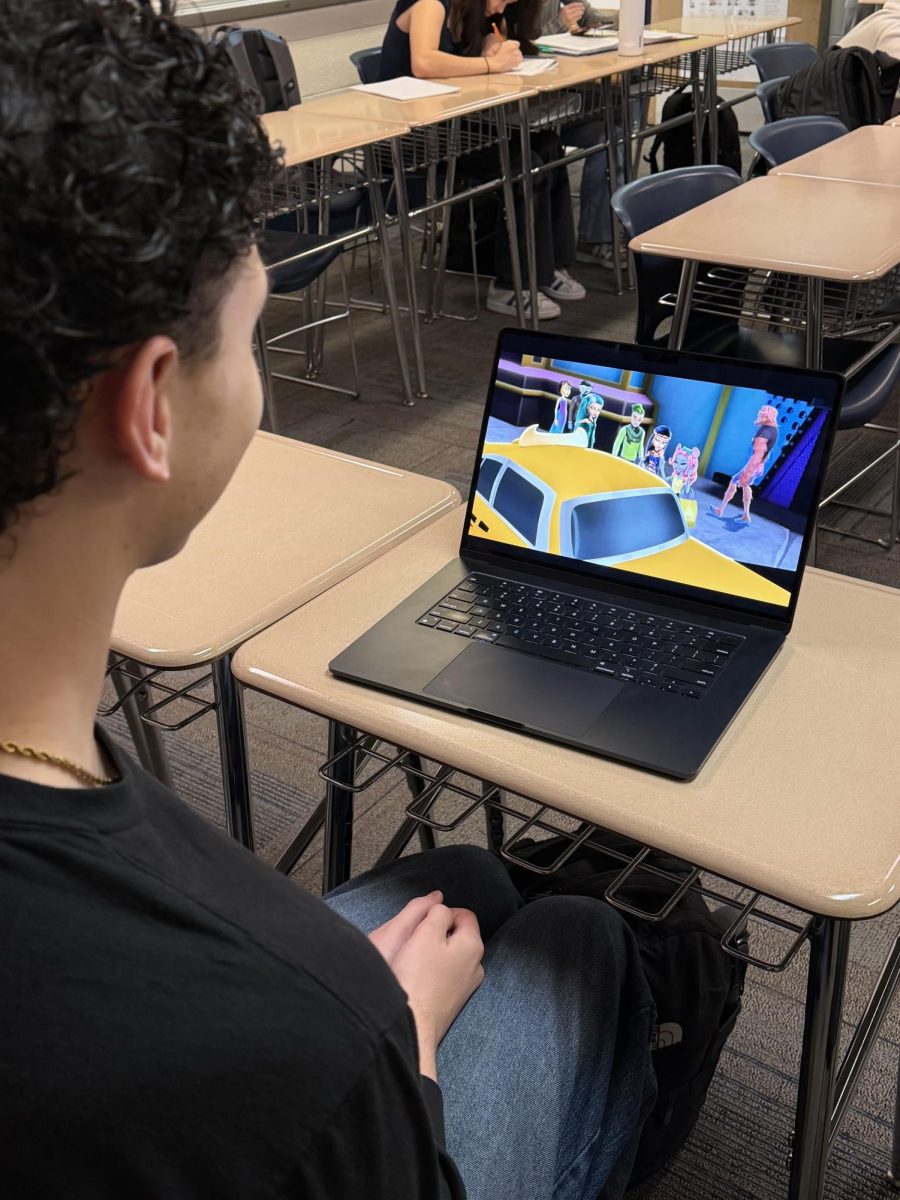
Student plays Wordle, one of New York Times most popular online games.
Brain games are an essential part of American culture, especially among teenagers and grandparents. Each brain game targets a different way of thinking and calls for the player to approach the problem in different ways. Here are the top 6 brain games rated on play frequency, brain stimuli, creativity and whether or not it’s fun:
- Wordle: A word game where the player is given six chances to guess a five-letter word, receiving feedback through colored tiles; most commonly played on the New York Times website. There is only one word a day preventing overplaying, as well as encouraging the player to maintain a daily streak. The simplicity yet rewarding word game is a staple of brain games.
- Candy Crush: Candy Crush is a puzzle game where the player must match three or more candies within a certain number of moves in order to obtain the perfect three stars. It often gives unique challenges, which makes the game simple yet engaging cognitively. A game that isn’t frequently thought of as a brain game, but further contemplation brings one to realize that Candy Crush is quite a brain teaser.
- Connections: Another New York Times game where one is given 16 different words or phrases to categorize into four groups. It calls the player to make connections (hence why it’s called connections) between four of the words to make a group. This is a fun, quick, yet brain-stimulating game that can be played alone or in a group. Connections wins in creativity as it forces the player to think differently about each word.
- Chess: Arguably the most challenging game cognitively, which involves no hidden information and no chance. It’s an abstract player versus player game where the ultimate goal is to checkmate the opposing competitor’s king. After the sixth move, there are already approximately 63 trillion chess positions. Chess definitely takes its place as one of the most challenging yet satisfying games to play.
- Crosswords: This game is certainly a fan favorite amongst the gramps. It’s a grid of squares with rows and columns where the player is called to fill in the box with words or phrases using the clue indicated for each square. This game requires the player to think creatively of synonyms, antonyms, and idioms, filling out each row or column. While the game demands a longer attention span, the reward can be gratifying
- Sudoku: A number grid game where the player must fill out the entire grid without breaking the constraints of the game: no repeating number within the row, column, and 3×3. This game pushes one to think logically as well as play deductively. Although there are some cells already filled in, the only way to solve this game is by logical reasoning. The game can take a while, but seeing the 9×9 grid filled out correctly makes the game very worthwhile.
- Worldle: Sounds very similar to Wordle, but the game is pretty different as it challenges the player’s cognitive brain geographically. The premise of the game is to guess the name of the country, given the shape of the country. This game can make one realize how little they know about the world. It is very fun to play and is pleasing to get the first try.